Case studies from systems we’ve designed and built for compliance, enterprise AI and child protection. Further down, interactive concepts from the ZIYVVO lab.
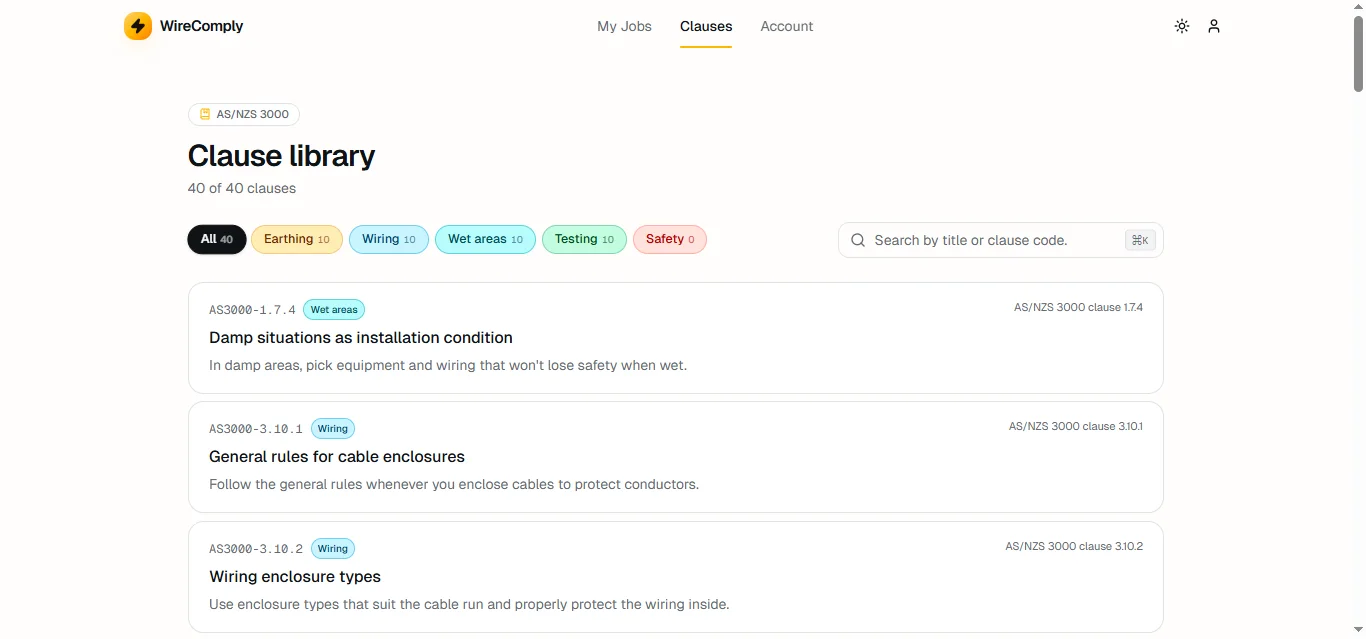
Multi-tenant SaaS for Australian electrical contractors. Ask a compliance question against a job, get clause-backed answers, generate a compliance pack PDF and push it straight to ServiceM8.
Of answers cite a clause code traceable to the standard
100%
The problem
Electricians make real safety decisions from these answers. A plausible but invented clause number is a liability, not a UX bug, so a general-purpose chatbot was never an option.
The solution
Retrieval decides, the model only formats. A keyword and category matcher scores a curated clause database, and only the matched clauses reach the model as grounding.
Zero matches short-circuits before the API call, so there is nothing to improvise from.
Outcomes
Every answer cites a clause code traceable to a page in the standard. 9/9 verified test queries return the correct clause, at roughly $0.0003 per question.
CASE STUDY / 02
Invenci AI Gateway
Multi-tenant enterprise AI platform
Enterprise AI · Governance
What it is
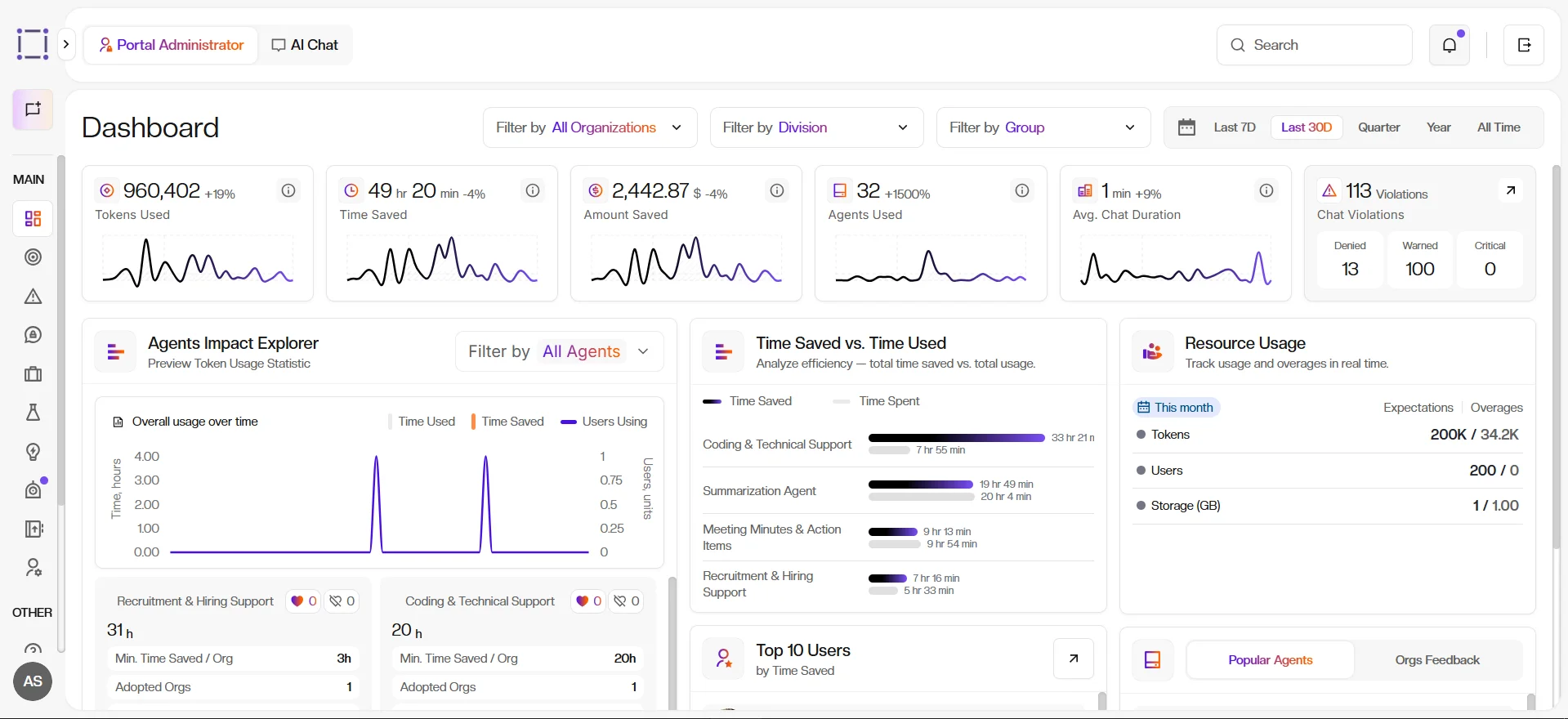
A governed gateway that sits between enterprise users and every major model provider. Tenants get chat, image generation, document and web-grounded retrieval, custom agents and an agent marketplace, with content firewalls, per-tenant model catalogues, role-based access, token entitlements and cost accounting applied across all of it. Each tenant runs as its own isolated deployment against its own database and model estate.
Evaluation tokens charged to a tenant’s user entitlement
0
The problem
The model landscape turns over every few weeks, and swapping the model behind an enterprise assistant is a bet placed with someone else’s money. Public benchmarks say nothing useful here: they don’t include your system prompt, your retrieved documents, your agents’ personas or your users’ actual questions.
The obvious answer, A/B testing in production, is unavailable when the tenant is a regulated business whose staff act on the answers. Teams were being asked to approve a migration on vendor marketing.
The solution
Replay, not benchmarking. At generation time the platform snapshots the exact assembled request (system prompt, conversation history, retrieved document and web context, sampling parameters) and treats that as the source of truth. An evaluation replays those same requests against a candidate model, then scores each pair with an LLM judge plus cosine similarity over embeddings, branching between text and image comparisons.
The hard part was fairness, and fairness turned out to be a system property rather than a prompt. The candidate receives the identical input including retrieved context. It runs through the very streaming function live chat uses, so it gets that model’s own configured token budget rather than an evaluation-specific one. It is governed by the incumbent’s content firewall rather than its own, since a stricter candidate firewall would block answers the original was allowed to give. And its response is unwrapped by the same extractor the chat pipeline uses, so prose is never compared against a JSON envelope.
Outcomes
Fifty-three checks across access control, discovery, validation, both modality lifecycles, cancellation, cost accounting and firewall behaviour, verified against live model deployments rather than mocks.
Every run is costed to operational spend and tagged with its own identifier, so “what did this evaluation cost” is answerable, while never touching the tenant’s user-facing token entitlement.
CASE STUDY / 03
SafetyNexus
AI practice coach for domestic violence caseworkers
Child protection · UK
What it is
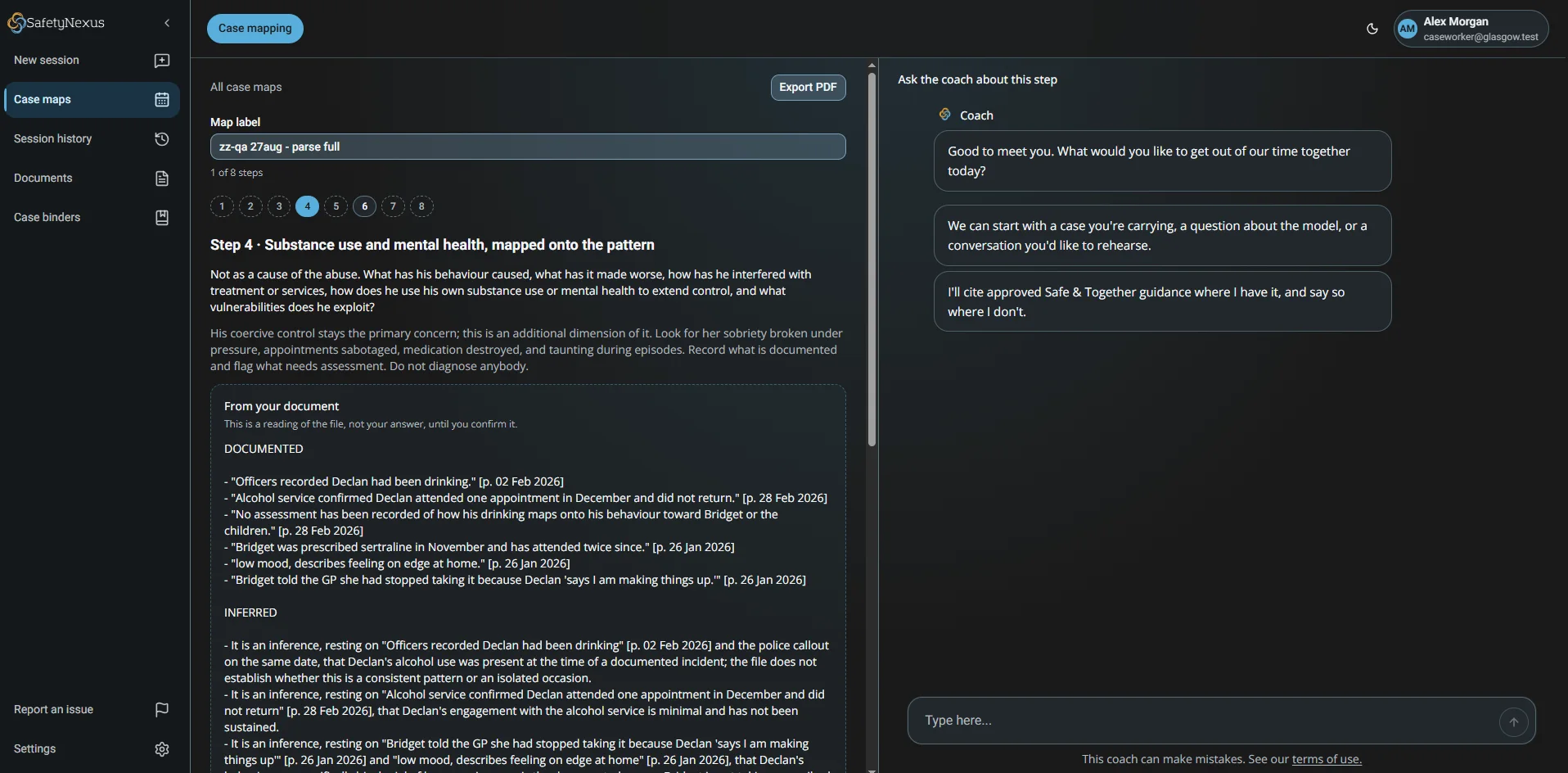
Multi-tenant SaaS for a practice institute that trains child-protection and social workers. A 24/7 coach grounded in the institute’s own practice model, a role-play simulator for rehearsing difficult conversations with survivors and perpetrators, and a structured case-mapping tool that reads uploaded case files. Deployed per jurisdiction with data residency guarantees.
+A coach that can be trusted in front of a live case
Crisis disclosures routed correctly over five runs
120/120
Safety score against a 95% commitment
99%
Automated tests
643
The problem
Caseworkers apply a complex practice model alone between training sessions, which produces drift (mother-blaming language, minimising the perpetrator) and burnout that degrades practice further.
A general-purpose chatbot is worse than nothing here: confident, plausible, wrong guidance in child protection isn’t a product problem, it’s a safety problem. The hard part was never building the chatbot. It was building one that could be trusted in front of a live case and proven to be, rather than asserted.
The solution
Answers are retrieved from the institute’s own corpus, and if nothing clears a measured relevance floor the coach says it doesn’t know instead of improvising. Every grounded claim carries a citation that stores the passage as it was at that moment, so an audit months later sees what the model actually saw, not what the document says now.
The decisions that matter aren’t the model’s. Crisis disclosures are classified and routed to legally reviewed wording before generation. Leaving a role-play is a string match a character cannot override. Nothing extracted from a case file counts until a worker accepts it, enforced by the schema rather than a rule.
Tenant isolation is row-level security in Postgres, and well-being conversations live on a physically separate database no admin console can reach.
Outcomes
Fidelity is measured, not claimed: over five repeat runs, crisis routing 120/120, honesty 100%, caveat compliance 100%, safety 99% against a 95% commitment. 643 tests. Generation and retrieval both run in London, so UK case material never leaves the jurisdiction.
Two failures are worth naming because tests found them and reading didn’t. The vector search had no relevance floor at all and returned six passages for “quokkasandwich”. The crisis screener caught one phrasing while six of nine realistic disclosures fell through. Every safety test passed throughout, because they asserted the mechanism and never the coverage.
+THE ZIYVVO LAB
Good ideas deserve a little exploration.
A space for trying things, connecting the dots, and making possibilities tangible. Open a concept and give it a spin.
03 EXPLORATIONS
Relay
A little less manual. A lot more connected.
Automation
Sales & operations / Concept
An interactive exploration of a lead moving from an incoming message to a structured CRM record and team handoff.
Workflow design
CRM
Automation
Read the concept brief
The challenge
An enquiry arrives in one tool. Its details and next steps end up scattered across several others.
The approach
Connect intake, a structured CRM record, and a team notification in one visible workflow.
The intended benefit
Designed to give each enquiry a clear next step and keep the handoff easy to follow.